Our last days in Vietnam

After our central Vietnam adventures, we boarded another sleeper bus to continue our journey through the country. It was definitely the best overnight trip so far- our „beds” were comfortable, legs weren’t squeezed, there even was fast WiFi available. Honestly, the long haul land transportation in Vietnam is not only very convenient and affordable but it can also be really enjoyable.
After a successful night of sleep, we arrived in Nha Trang- a coastal city located in the south of Vietnam. We stopped there in need for some sun- at that point we were quite desperate to feel sunshine on our faces after the nonstop rainfall we experienced in Hue and Hoi An (no complaints, we still enjoyed our stay). We also wanted to stop to enjoy the nice beaches while avoiding the direct 20-hour long bus ride from Hoi An to Saigon.
It was pretty simple to realize something we had no clue about before coming. Nha Trang felt like a Russian province. Russians everywhere, menus in Russian first, then Vietnamese and English, waiters greeting you with „dobry wieczor”. We obviously didn’t like it and quickly decided to leave as soon as possible, but since we were there already, we could at least try to find some authenticity in Nha Trang anyway. We were on a mission. Turns out when you move away from the sea front (a 20-30 minute walk maybe) you enter a completely different world- you’re back in Vietnam, there are no signs of Russians and you actually end up in one of the least crowded and the most relaxed, authentic places on your trip.
On our first, yet another gloomy day, we explored the Ponagar Temple- the impressive Cham temple complex built between the 7th and 12th centuries. The temple is beautifully located on a hill overlooking a river and the South China Sea. It’s a really unique artistic and architectural work of the ancient Cham people, whose Kingdom was thriving there at that period. Another place on our schedule was the Long Son Pagoda, where climbing up 152 stairs led us to see a giant white Buddha watching over the city.
After admiring these special sites, we moved onto one of my favorite things to do, which is exploring the local markets. Watching the vendors and their products, all the fresh produce which seems more familiar to us at this point, listening to them chatter (or scream over each other) somehow makes you feel lost and very present in this world for some reason. We didn’t leave empty handed- Nha Trang seemed to be the national capital of dried mango. Mangoes here, fresh or dried, are insanely juicy and delicious, it’s impossible not to give into temptation.
We got more lucky with the weather on the second day of our stay in Nha Trang, as per forecast, the sun was finally out and we couldn’t be more happy to see the blue skies- we dedicated the day to the beach, reading and walking. The sea was beautiful and showed off its power to the visitors with magnificent waves rising up to 5m in height. I find a lot of beauty in moments like these- walking on a beach on a sunny day, light wind in my hair, nowhere to go really, watching the waves wash my feet.
It was time to leave our Russian base early the next morning. We got picked up at our hotel and we left off for a few hour bus ride to Dalat- the city of eternal spring. It was supposed to take 2,5hours to get to our destination but due to a roadblock, we needed to take a last minute detour resulting in a 4 hour ride instead. What a ride it was! Probably the most bumpy one ever, we were literally jumping on our seats as our driver was racing and recklessly overtaking on the hilly turns. Vietnamese bus drivers’ worst nightmare clearly is not being the first one on the road. The adventurous ride was a bit nauseating but also fun and allowed us to peek into the daily lives of the villagers and to admire the mountainous landscapes in the morning sun. Dalat is known as „the city of eternal spring”. Due to its mild climate and slightly cooler temperatures, it makes a perfect environment for the flowers to bloom all year long. It was pretty hard for me to imagine experiencing spring in the middle of December but I guess everything is possible in Vietnam- it really felt like a nice and sunny spring day when we arrived. We quickly checked into our homestay, had a vegetarian buffet lunch (rating in one of the pictures below) and went on a long walk around the Dalat lake, admiring all the colorful flowers in full bloom and taking some detours to see the city sights- one of them being a huge glass artichoke, the city’s signature vegetable. Dalat is also home to banh mi xiu mai- a twist on a banh mi- this time you dip the plain baguette in a spicy sauce, it’s really delicious.
We spent the next morning strolling around the streets of Dalat, visited a local market, a colonial church, where we finally saw signs of upcoming Christmas.
It was a short and sweet stay, wish we could stay for longer, but it was time to head to our final destination in Vietnam, Saigon, or Ho Chi Minh City by its current name.
Saigon was renamed Ho Chi Minh City in 1975 after the president of Vietnam who led the country to victory in the Vietnam war. We arrived in the city quite late, but that didn’t make the city life any less hectic. This place felt like Hanoi’s little brother. Streets full of scooters and cars, food stalls all over, and by that time, plenty of Christmas decorations.
In the morning we started our day by having a local squid soup for breakfast. Very unique, very delicious. Afterwards we strolled around the most famous sights of the city. In the center: Opera house, Post Office, Notre Dame Cathedral, all built by the French. We also found a little street behind the Post Office building that was filled with books, book stalls and cafes with books. Here we also enjoyed a nice passion fruit juice, our newly discovered passion (hehe).
We made our way a bit further out of the center to a Buddhist pagoda. From the outside it didn’t look much different than a normal building, but on the inside there we multiple halls for praying and offerings. For lunch we decided to try the banh mi stall that was featured in Netflix’s „Street food” documentary series. It was above average, not disappointing, not extraordinary either. Finally, we stopped by a funky pink Christian cathedral. Unfortunately it was closed for the afternoon so we could only admire it from the outside.
To finish our day, we explored the most popular museum/exhibition in the city, the War remnants museum. This museum was all about displaying the horrible things that happened in Vietnam during, and after the war, the ways the Vietnamese fought back, and ultimately defeated the Americans in 1975. We wanted to visit the museum before our trip to the nearby Cu Chi village and its tunnels the following day.
For dinner, we had the pleasure of experiencing the hospitality of our homestay hosts. Our homestay was quite literally just a normal home, where the residents rented out their unused rooms. Every day at 7pm the guests are invited for dinner. We got to enjoy some delicious Vietnamese home-cooking with two Australian girls who were also staying there. After stuffing our bellies and saying our thank yous and goodbyes we went to bed in anticipation of the adventures of the following day.
The Cu Chi tunnels are a famous destination due to the extensive tunnel system the Viet Cong (the communist rebel army in South Vietnam) built underground during the war to escape from and fight back against the Americans. The jungle was filled with replicas of various kinds of traps, hiding holes and bomb craters. The creativity and resourcefulness of the Vietnamese people is truly impressive. For instance: using the rubber from the tires of defeated American vehicles to craft sandals, that they wore backwards, to misdirect the enemy about their movements. Of course sometimes they would wear them correctly to cause even more confusion.
The most impressive accomplishment, however, was the multi-layered tunnel structure that was constructed during the war, over an area of hundreds of square kilometers. Thanks to the tunnels they were able to effectively hide from and fight against their invaders. The tunnels featured multiple fake entrances, traps, and defence mechanisms against toxic gases that the Americans tried to use to eliminate the enemy forces.
We also got to try one of the tunnels. To put into perspective the physical effort it takes to use the tunnels, our legs were giving in after only 60m of crouch-walking in the ever-narrowing tunnel passage. Granted, neither of us are in Olympic physical condition, and crawling is less tiring than crouch-walking, it still gives an idea of the effort and persistence the Vietnamese displayed to defend their independence.
The option to fire a gun on a nearby shooting range was also part of the experience, of course not for free. In the end we decided against it, since we would have had to pay good money to essentially only pull the trigger a few times, which is far from the real „gun experience”. Either way, an interesting and very loud attraction to observe.
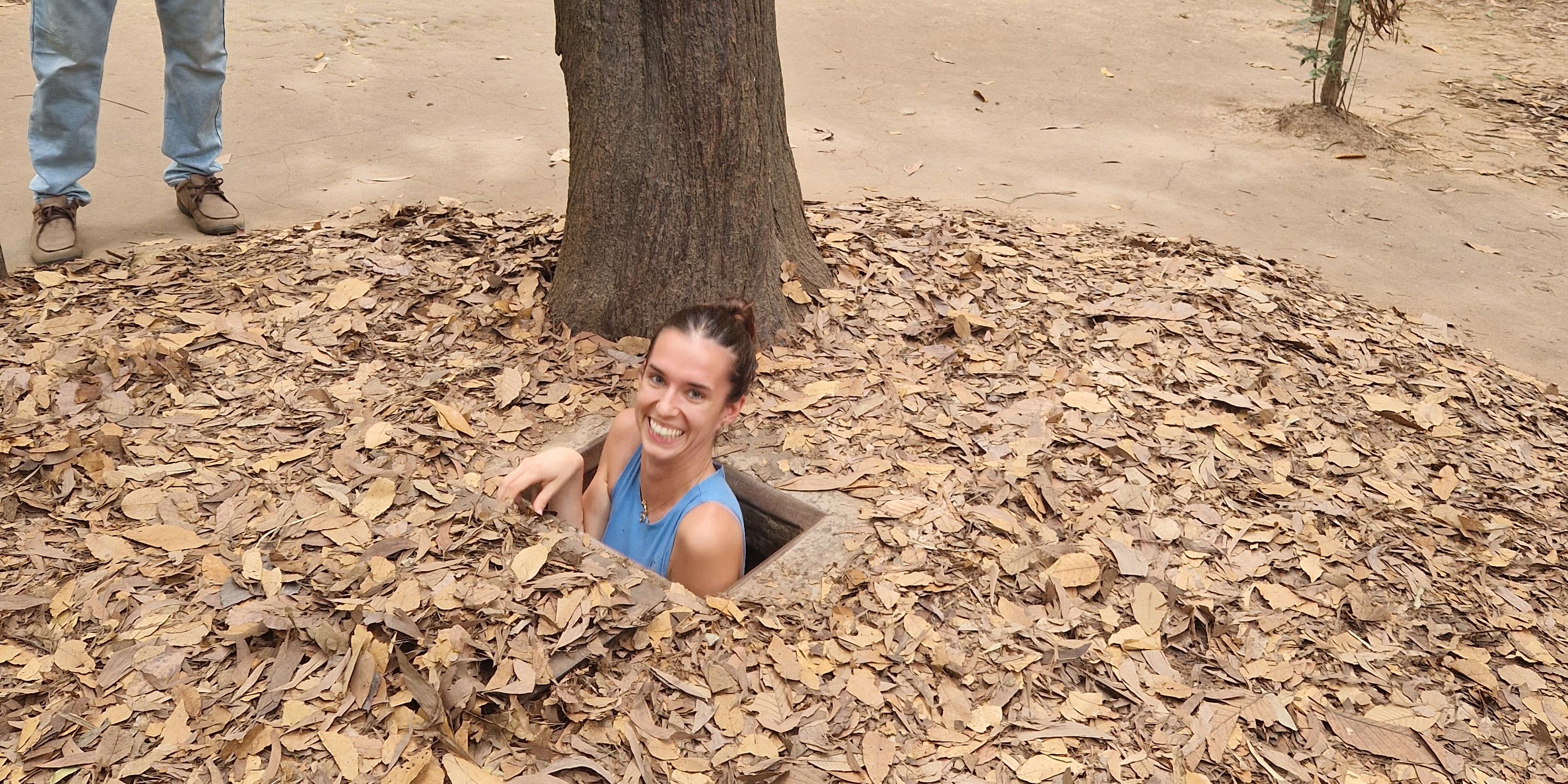
Our last stop of the tour was a hiding hole in the ground that fits one person, and is invisible to the outside when covered. The Vietnamese used these holes to great effect for ambushing the enemy. A simple but deadly resource.
After a short rest at our homestay, we explored a nearby mall and later educated ourselves (entry card, visa, etc.) about our next destination: Cambodia.
Our final day in Vietnam consisted mainly of preparations and saying goodbye to the lovely country where we had spent our previous 4 weeks. But as the saying goes: Don’t be sad because it’s over, be happy because it happened.


